


I just finished watching Jim Carrey’s, A Christmas Carol. There are so many versions of this story. Some are funny, some are scary, some are set in 1800s London, some are set in a modern city like New York, some are animated, and some are live-action. There are, of course, certain elements they all have in common. However, what if we completely changed the story?
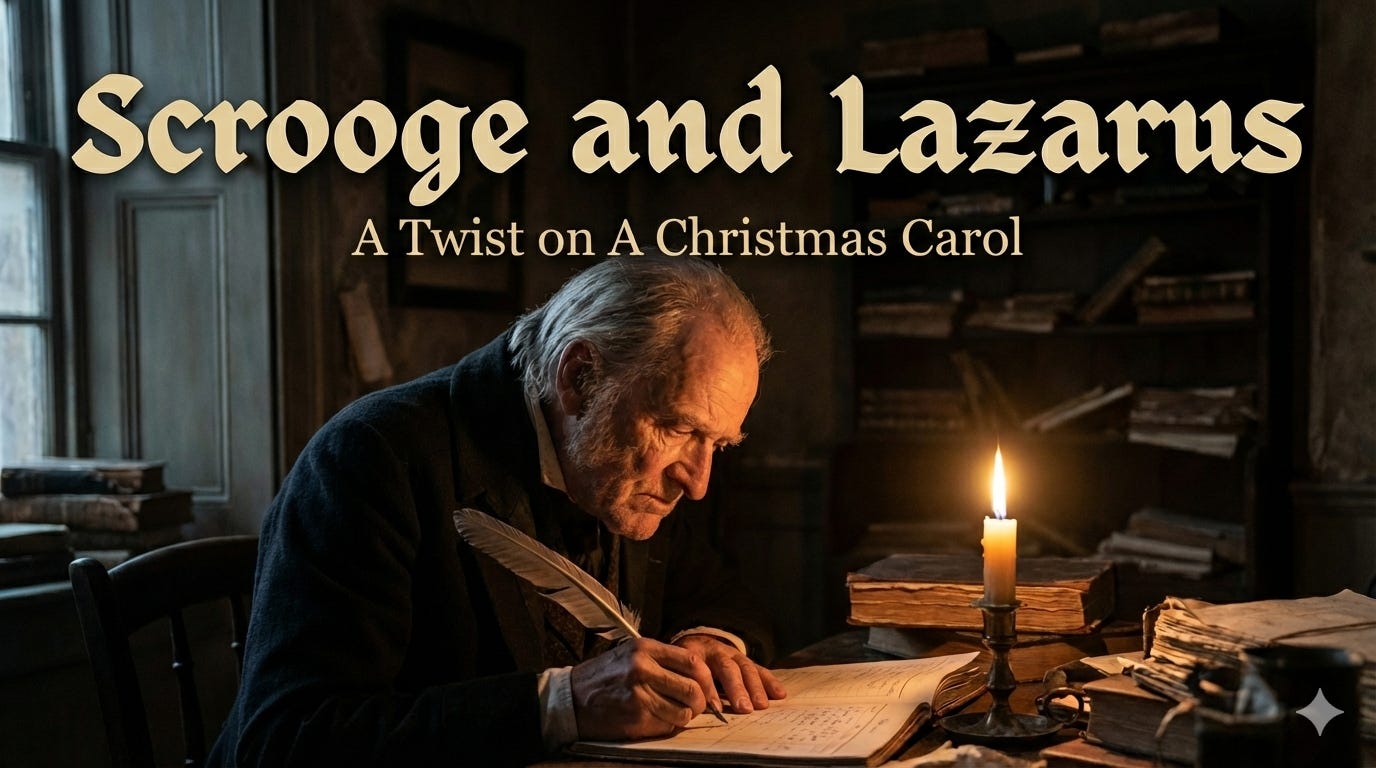
A Twist on A Christmas Carol
Imagine how surprising it would be if someone made a version of the story in which Ebenezer Scrooge’s business partner, Jacob Marley, died but did NOT come back to haunt Scrooge. The ghost of Jacob Marley is being tormented in chains because of his greed. Then, he asks for permission to go to earth and warn his old business partner about where the love of money, and neglect of the poor, will lead. However, Jacob Marley is denied permission to go back and warn Scrooge.
So, Marley proposes, “What if the spirits of Christmas past, present, and future go to earth and warn Scrooge about his greedy ways?” Again, this idea is shot down. Marley is told that Ebenezer already has all the information he needs to turn his life around. If he won’t listen to all the people preaching about generosity, kindness, fairness, and justice, he won’t listen to a bunch of ghosts. Abruptly, the story simply ends there.
This would be a very short, surprising, and somewhat depressing version of A Christmas Carol. Yet, this is almost exactly what Jesus did when he told the story we call, “The Rich Man and Lazarus” (Luke 16:19-31).
The Rich Man and Lazarus
Several biblical scholars say that stories like the rich man and Lazarus were very familiar to the people in Jesus’ day. A rich man and a poor man both die, but their lots in the afterlife are reversed from what they were on earth. The poor man is in paradise and the rich man is in torment. The rich man is allowed to go and warn the living to repent of their greedy ways before it is too late. These are the common elements to all the versions of the story.
However, Jesus subverted his audience’s expectations by saying Father Abraham denied the living the opportunity to be warned by the dead. I imagine the people listening to Jesus’ story thought, “Wait! That’s not how the story is supposed to go! You’re telling it wrong.”
But the twist in Jesus’ version is where the point lies. Jesus ended his story by having Abraham say, “If they do not hear Moses and the Prophets, neither will they be convinced if someone should rise from the dead” (Luke 16:31).
Of course, this was a strong word of condemnation against the Pharisees, “who were lovers of money” (Luke 16:14). The Pharisees were the Scrooge of Jesus’ day. He was making the point that if they won’t listen to Scripture telling them to love kindness, do justice, and show mercy, then a scary story about torment in the afterlife won’t convince them. Of course, his words also foreshadowed his own resurrection and the unwillingness of his generation to believe and repent.
Don’t Be a Scrooge
By putting a twist on a familiar story like this, Jesus is really driving home his point. I believe he is saying no one should be so hardhearted that they have to be scared into generosity. People had already been told what to do with their money, they had already been warned by Moses and the prophets, but they still were not convinced. So, instead, they had to make up stories about the tortured dead coming back to scare people into submission.
I’m afraid many of us have done that with the story of the Rich Man and Lazarus. Rather than accepting the clear admonition to be generous to the poor because God has told us to be, we have turned it into a story to scare one another into submission. Or, even worse, we have completely overlooked the message about generosity and have made it a theological treatise on the afterlife.
Are we moved to generosity? What moves us? The command of God? Seeing our neighbors—the widow, the orphan, the immigrant, and the poor—in need? Or a ghost story we have heard a million times? Jesus told the Pharisees, “You are those who justify yourselves before men, but God knows your hearts” (Luke 16:15). Let’s not be like them. Let’s have a tender heart that is easily moved to generosity.
I love you and God loves you,
Wes McAdams
I've found proof that this story was not originally written by Charles Dickens, who merely plagiarized it and re-wrote it as a ghost story to make quick cash. I've identified the real co-authors as my historical research subjects, an American couple named Mathew and Abby Whittier. Abby was the source of all the spirituality in "A Christmas Carol." It was she who named the chapters "staves," which has a double meaning Dickens never picked up on. A "stave" can also mean a rung on a ladder, and so each chapter was a rung on the ladder to the reader's conversion experience, as he or she identified with Ebenezer (not "Scrooge"). Abby was a Catholic mystic who, somewhat like Thomas Merton, respected other esoteric traditions. She was persecuted as a witch by traditional Protestants in her brief 24 years. Traditional Christians are up against a dilemma--if they believe Charles Dickens wrote this story, they will find that Dickens is being gradually exposed as a scoundrel. But if they understand that it was written by Mathew and Abby, they have to admit that such spiritual power came from people they might be inclined to think of as heretics.
thesacredcarol dot goldthread dot com
I wonder if Jesus’ disinterest in addressing this comes from his complete love for God. We cannot serve two masters. If the Scrooge-like nature of people is to change, it oughtn’t be out of self-interest or self-preservation (avoiding one’s eternity of misery), but out of love for God and others.